







Locate Before Digging
Georgia law requires a locate request through 811 before digging. Public lines are marked for free, but the line from the meter to the house generally needs a private locator.


Six contiguous historic districts, mature trees and finished yards shape how a buried water line is located, repaired or replaced. Here is how that looks across MidTown.
Midtown (also written MidTown) is the part of Columbus, Georgia that fans out along Wynnton Road, east of Uptown. Per MidTown, Inc., it spans 24 neighborhoods and historic districts. According to Historic Columbus, six of them are contiguous National Register historic districts: Weracoba–St. Elmo, Overlook, Dinglewood, Wynnton Village, Peacock Woods–Dimon Circle and Wildwood Circle–Hillcrest. This page covers Midtown as a whole and the three districts that do not have a page of their own. For the rest of the city, start at the Columbus water line service overview.
Three of the six get a closer look elsewhere. Wynnton covers Wynnton Village and the Wynn's Hill–Overlook–Oak Circle district along the ridge, and Weracoba–St. Elmo covers the Lakebottom park and creek side of Midtown. Hilton Heights and Clubview Heights are also inside Midtown. They are mid-century subdivisions rather than historic districts, and they have their own page: Hilton Heights and Clubview Heights.
Dinglewood is one of the smaller districts. According to MidTown, Inc., Col. Joel Early Hurt bought about 30 acres here and finished an Italianate house in 1859, and the estate was subdivided into single-family lots between 1917 and 1946. The district is known for a privately owned circular park and a city-owned park. The National Register listing dates to November 21, 2001. Homes on lots carved from an estate can sit at odd angles to the street, so the path from the meter to the house is worth tracing on your own property before anyone digs.
Peacock Woods–Dimon Circle was started in 1922. MidTown, Inc. describes John Flournoy's Peacock Woods on the north side, laid out by landscape architect Earle S. Draper with curving streets and park-like settings, and Samuel Kelly Dimon's Dimon Circle to the south. Its styles run from Colonial Revival and Craftsman to English Vernacular Revival and Spanish Colonial Revival. Curving streets and large shade trees are worth knowing about when a trenchless water line replacement is being considered, because a bore path has to work around what is above and below ground.
Wildwood Circle–Hillcrest is bounded by Wildwood Avenue, 13th and 17th Streets and Dixon Drive, according to its National Register nomination, and contains 94 contributing buildings. It grew out of John F. Flournoy's 1890 Queen Anne house, Hillcrest, built on what the nomination calls the highest hill in the Wynnton area. His children built houses here from 1906 to 1951, and Flournoy's real-estate company subdivided Wildwood Circle in 1911. Homes built across that span, on hilly ground, are a good reason to start with underground leak detection before deciding between spot repair and main water line replacement.
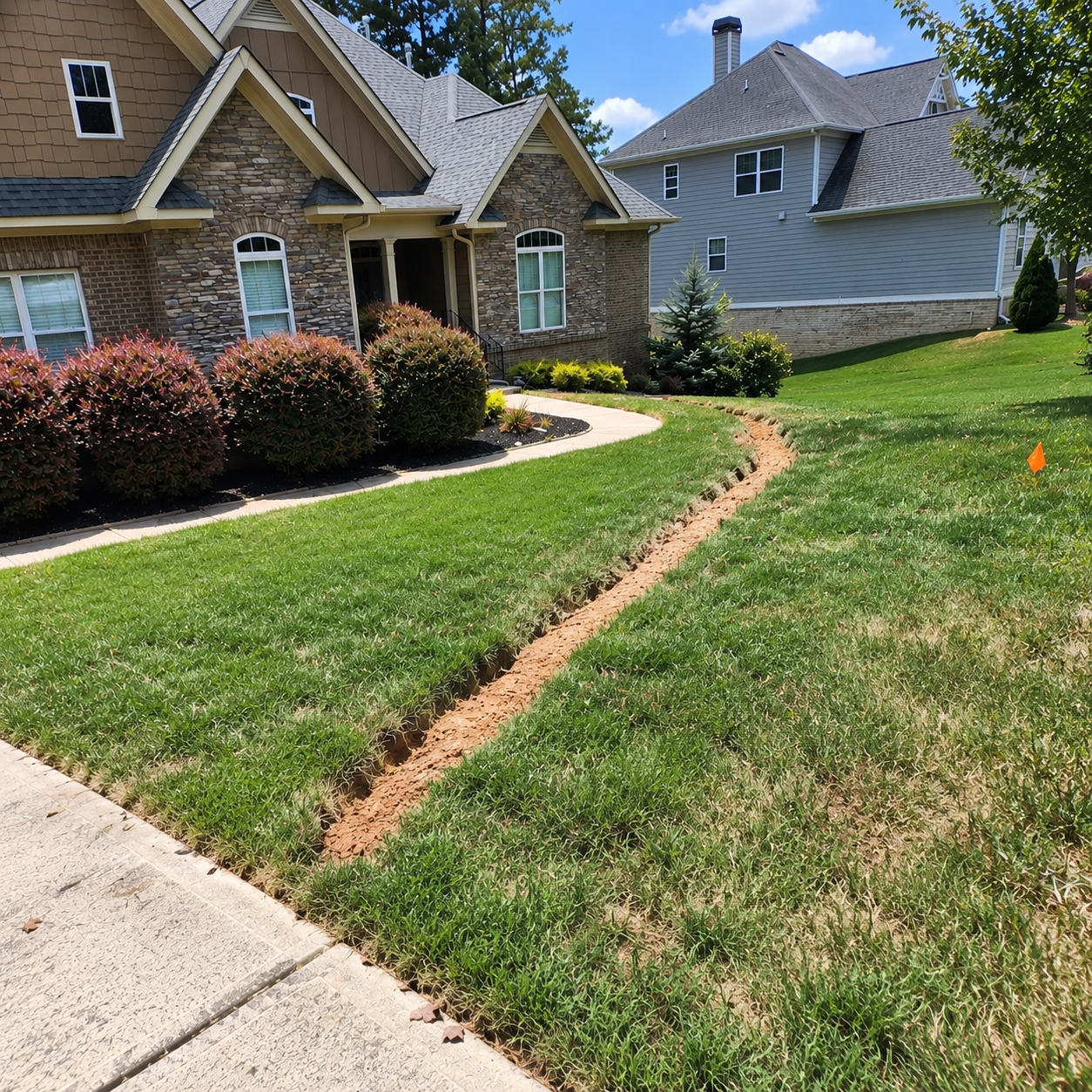
Georgia law requires a locate request through 811 before digging. Public lines are marked for free, but the line from the meter to the house generally needs a private locator.
Homes from the 1910s to the 1950s may have an original line, a replaced one or a mix. Neighborhood age does not tell you what your own line is made of.
Columbus Water Works maintains the public lateral to a point just past the meter. The owner maintains the private lateral to the house.
If a project touches the exterior of a property in a designated district, it is reasonable to ask the Columbus historic preservation office early. We are not stating a rule for buried lines.
The services on this page fit any Midtown yard: leak detection to find a problem before digging, spot repair, full replacement, trenchless replacement and directional boring for crossing hardscape. The right one depends on where the line runs and what sits above it.
On the smaller districts, that often means a circular park frontage, a hillside, a curving street or a mature oak beside the meter. Those details change access, so a site look matters more than the address.
If you have a wet spot, a bill that climbed or a pressure drop in a Midtown home, tell us what you are seeing through the contact form. We will help you understand your options, and there is no obligation to move forward.
The roads listed here are named in the historic-district documentation and are for orientation only, not a claim about any service boundary. For a broader look at the city, see the Columbus overview.
Learn more about underground water lines in Midtown Columbus and make informed decisions about your project.
Questions we hear from owners of homes in Midtown's historic districts.
Tell us about your property. We'll help you understand your options, with no obligation to move forward.
Midtown (also written MidTown) is the part of Columbus, Georgia that fans out along Wynnton Road, east of Uptown. Per MidTown, Inc., it spans 24 neighborhoods and historic districts. According to Historic Columbus, six of them are contiguous National Register historic districts: Weracoba–St. Elmo, Overlook, Dinglewood, Wynnton Village, Peacock Woods–Dimon Circle and Wildwood Circle–Hillcrest. This page covers Midtown as a whole and the three districts that do not have a page of their own. For the rest of the city, start at the Columbus water line service overview.
Three of the six get a closer look elsewhere. Wynnton covers Wynnton Village and the Wynn's Hill–Overlook–Oak Circle district along the ridge, and Weracoba–St. Elmo covers the Lakebottom park and creek side of Midtown. Hilton Heights and Clubview Heights are also inside Midtown. They are mid-century subdivisions rather than historic districts, and they have their own page: Hilton Heights and Clubview Heights.
Dinglewood is one of the smaller districts. According to MidTown, Inc., Col. Joel Early Hurt bought about 30 acres here and finished an Italianate house in 1859, and the estate was subdivided into single-family lots between 1917 and 1946. The district is known for a privately owned circular park and a city-owned park. The National Register listing dates to November 21, 2001. Homes on lots carved from an estate can sit at odd angles to the street, so the path from the meter to the house is worth tracing on your own property before anyone digs.
Peacock Woods–Dimon Circle was started in 1922. MidTown, Inc. describes John Flournoy's Peacock Woods on the north side, laid out by landscape architect Earle S. Draper with curving streets and park-like settings, and Samuel Kelly Dimon's Dimon Circle to the south. Its styles run from Colonial Revival and Craftsman to English Vernacular Revival and Spanish Colonial Revival. Curving streets and large shade trees are worth knowing about when a trenchless water line replacement is being considered, because a bore path has to work around what is above and below ground.
Wildwood Circle–Hillcrest is bounded by Wildwood Avenue, 13th and 17th Streets and Dixon Drive, according to its National Register nomination, and contains 94 contributing buildings. It grew out of John F. Flournoy's 1890 Queen Anne house, Hillcrest, built on what the nomination calls the highest hill in the Wynnton area. His children built houses here from 1906 to 1951, and Flournoy's real-estate company subdivided Wildwood Circle in 1911. Homes built across that span, on hilly ground, are a good reason to start with underground leak detection before deciding between spot repair and main water line replacement.
Georgia law requires a locate request through 811 before digging. Public lines are marked for free, but the line from the meter to the house generally needs a private locator.
Homes from the 1910s to the 1950s may have an original line, a replaced one or a mix. Neighborhood age does not tell you what your own line is made of.
Columbus Water Works maintains the public lateral to a point just past the meter. The owner maintains the private lateral to the house.
If a project touches the exterior of a property in a designated district, it is reasonable to ask the Columbus historic preservation office early. We are not stating a rule for buried lines.
The services on this page fit any Midtown yard: leak detection to find a problem before digging, spot repair, full replacement, trenchless replacement and directional boring for crossing hardscape. The right one depends on where the line runs and what sits above it.
On the smaller districts, that often means a circular park frontage, a hillside, a curving street or a mature oak beside the meter. Those details change access, so a site look matters more than the address.
If you have a wet spot, a bill that climbed or a pressure drop in a Midtown home, tell us what you are seeing through the contact form. We will help you understand your options, and there is no obligation to move forward.
The roads listed here are named in the historic-district documentation and are for orientation only, not a claim about any service boundary. For a broader look at the city, see the Columbus overview.
Learn more about underground water lines in Midtown Columbus and make informed decisions about your project.
Questions we hear from owners of homes in Midtown's historic districts.
Per MidTown, Inc., Midtown includes 24 neighborhoods and historic districts. Six contiguous National Register districts sit along Wynnton Road, and Hilton Heights and Clubview Heights are also part of Midtown.
Not necessarily. Dinglewood lots were platted between 1917 and 1946, and Hillcrest-area homes date from 1906 to 1951, but a line may have been replaced since. Only the line itself shows its material.
The listing describes a neighborhood's architecture and history. It does not change who maintains the water line, which follows the meter rule from Columbus Water Works.
If a project touches the exterior of a property in a designated district, asking the Columbus historic preservation office is a sensible first step. We are not stating that buried line work requires approval.
Columbus Water Works describes reading the meter before bed and again in the morning before using water; a higher second reading may mean a leak. Some guides use a two-hour version with no water in use.
It can affect access, since trenchless entry and exit points need workable space. Whether a bore path fits is decided at the property, and some jobs still call for an open trench.
Tell us about your property. We'll help you understand your options, with no obligation to move forward.
Call (770) 676-1685