

Call 811 First
Georgia law requires a locate request before digging. Georgia 811 marks public lines for free, but the line from your meter to the house is generally private and needs a private locator.

A local guide to the buried water line on your Columbus property: who maintains each section, who to contact before digging, and which underground services fit the job.
Columbus Water Works (CWW) describes two sections of pipe between the street and your house. The public service lateral runs from the water main to a connection point just past the meter, and CWW maintains it. The private service lateral connects to your building's plumbing, and the property owner maintains it. A leak between the meter box and the street is CWW's to repair; a leak on your side of the meter is yours to find and fix, which is where a buried-line specialist comes in.
Columbus and Muscogee County operate as one consolidated government. Plumbing permits go through Columbus Inspections & Code Enforcement, and work in the public right-of-way goes through Columbus Engineering. Our guide to water line work in Columbus covers 811, permits and right-of-way, and the meter-to-house responsibility guide explains the split in more detail.
Start with where your property sits. Midtown Columbus is the umbrella for six National Register historic districts, according to Historic Columbus, and its neighborhoods have their own pages: Wynnton, annexed into Columbus in 1925; Weracoba–St. Elmo, known for 1920s to 1940s bungalows; and Hilton Heights and Clubview Heights, mid-century streets that began in the 1940s.
North of that, North Columbus is a broad, commonly described area with housing from many decades, and Green Island Hills has its own history along Standing Boy Creek and River Road, dating to 1905. Citywide, the Census Bureau's 2024 American Community Survey shows about half of Columbus housing units were built before 1980, so line age and material vary from home to home. Columbus also sits on the Fall Line, where the Piedmont meets the Coastal Plain, so soils range from clay to sandy. That is general background, not a diagnosis for any one yard.
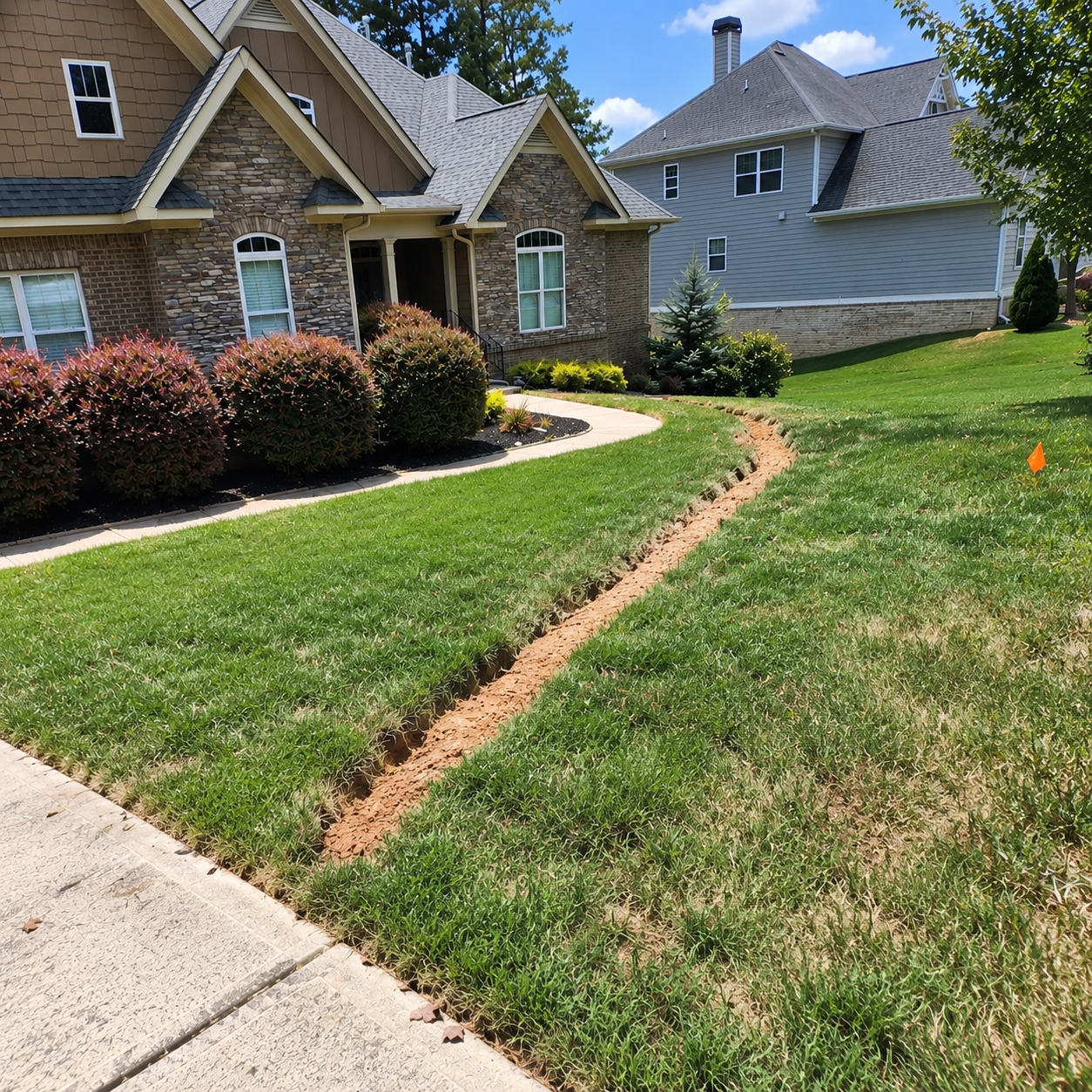
Georgia law requires a locate request before digging. Georgia 811 marks public lines for free, but the line from your meter to the house is generally private and needs a private locator.
According to Columbus Water Works, its inspection found no lead service lines or laterals in the Columbus system. You can look up your address on CWW's material map.
CWW maintains the public lateral up to a point just past the meter. From there to the building, the property owner maintains the private lateral.
Columbus Inspections & Code Enforcement handles plumbing permits, and Columbus Engineering handles right-of-way encroachment permits. Confirm what your project needs before work begins.
The services below cover the buried line between the meter and the house: finding a leak, repairing a section, replacing the line, and trenchless options when a yard, driveway or landscaping is in the way. Which one fits depends on what the line and the property look like once the problem is located.
A wet patch in the yard, a water bill that jumped, or pressure that dropped without explanation are all reasons to have the buried line looked at. Reach out with what you're seeing and we'll help you understand your options. There is no obligation to move forward.
Roads such as Veterans Parkway, Manchester Expressway, J.R. Allen Parkway, Macon Road, Wynnton Road, Victory Drive, Buena Vista Road and Warm Springs Road run through many parts of Columbus. They are listed for orientation only, not as a claim about any service boundary.
Learn more about underground water lines in Columbus and make informed decisions about your project.
Common questions from Columbus, GA homeowners about the buried water line.
Tell us what's going on with your line. We'll help you understand your options, with no obligation to move forward.
Columbus Water Works (CWW) describes two sections of pipe between the street and your house. The public service lateral runs from the water main to a connection point just past the meter, and CWW maintains it. The private service lateral connects to your building's plumbing, and the property owner maintains it. A leak between the meter box and the street is CWW's to repair; a leak on your side of the meter is yours to find and fix, which is where a buried-line specialist comes in.
Columbus and Muscogee County operate as one consolidated government. Plumbing permits go through Columbus Inspections & Code Enforcement, and work in the public right-of-way goes through Columbus Engineering. Our guide to water line work in Columbus covers 811, permits and right-of-way, and the meter-to-house responsibility guide explains the split in more detail.
Start with where your property sits. Midtown Columbus is the umbrella for six National Register historic districts, according to Historic Columbus, and its neighborhoods have their own pages: Wynnton, annexed into Columbus in 1925; Weracoba–St. Elmo, known for 1920s to 1940s bungalows; and Hilton Heights and Clubview Heights, mid-century streets that began in the 1940s.
North of that, North Columbus is a broad, commonly described area with housing from many decades, and Green Island Hills has its own history along Standing Boy Creek and River Road, dating to 1905. Citywide, the Census Bureau's 2024 American Community Survey shows about half of Columbus housing units were built before 1980, so line age and material vary from home to home. Columbus also sits on the Fall Line, where the Piedmont meets the Coastal Plain, so soils range from clay to sandy. That is general background, not a diagnosis for any one yard.
Georgia law requires a locate request before digging. Georgia 811 marks public lines for free, but the line from your meter to the house is generally private and needs a private locator.
According to Columbus Water Works, its inspection found no lead service lines or laterals in the Columbus system. You can look up your address on CWW's material map.
CWW maintains the public lateral up to a point just past the meter. From there to the building, the property owner maintains the private lateral.
Columbus Inspections & Code Enforcement handles plumbing permits, and Columbus Engineering handles right-of-way encroachment permits. Confirm what your project needs before work begins.
The services below cover the buried line between the meter and the house: finding a leak, repairing a section, replacing the line, and trenchless options when a yard, driveway or landscaping is in the way. Which one fits depends on what the line and the property look like once the problem is located.
A wet patch in the yard, a water bill that jumped, or pressure that dropped without explanation are all reasons to have the buried line looked at. Reach out with what you're seeing and we'll help you understand your options. There is no obligation to move forward.
Roads such as Veterans Parkway, Manchester Expressway, J.R. Allen Parkway, Macon Road, Wynnton Road, Victory Drive, Buena Vista Road and Warm Springs Road run through many parts of Columbus. They are listed for orientation only, not as a claim about any service boundary.
Learn more about underground water lines in Columbus and make informed decisions about your project.
Common questions from Columbus, GA homeowners about the buried water line.
According to Columbus Water Works, CWW maintains the public service lateral, which runs from the main to a point just past the meter. The property owner maintains the private service lateral that connects to the building.
Usually not. Georgia 811 marks public lines for free, but the line from the meter to the house is generally considered private. A private locating service or a plumber can locate it.
There are pages for Midtown Columbus, Wynnton, Weracoba–St. Elmo, Hilton Heights and Clubview Heights, North Columbus and Green Island Hills. Each covers that area's history and what it means for a buried water line.
The responsibility split, 811 rules and permit offices are the same citywide. Start with the closest page for geographic context, then use the meter check and CWW's material map for your own line.
Columbus Inspections & Code Enforcement issues plumbing permits, and the right-of-way requires an encroachment permit through Columbus Engineering. Whether your specific project needs a permit should be confirmed with Inspections & Code, and the contractor normally handles it.
Columbus Water Works reports that its inspection found no lead service lines or laterals in the Columbus system. It publishes a searchable material map on its website so you can check your address.
Tell us what's going on with your line. We'll help you understand your options, with no obligation to move forward.
Call (770) 676-1685